Web Audit
Hidden Costs of a Slow or Broken Website
Your website may not be completely broken. Your homepage may still load, your navigation may appear to work, and customers may still be able to contact you. From the outside, everything can seem normal.
Synoloop Solutions 5 min read
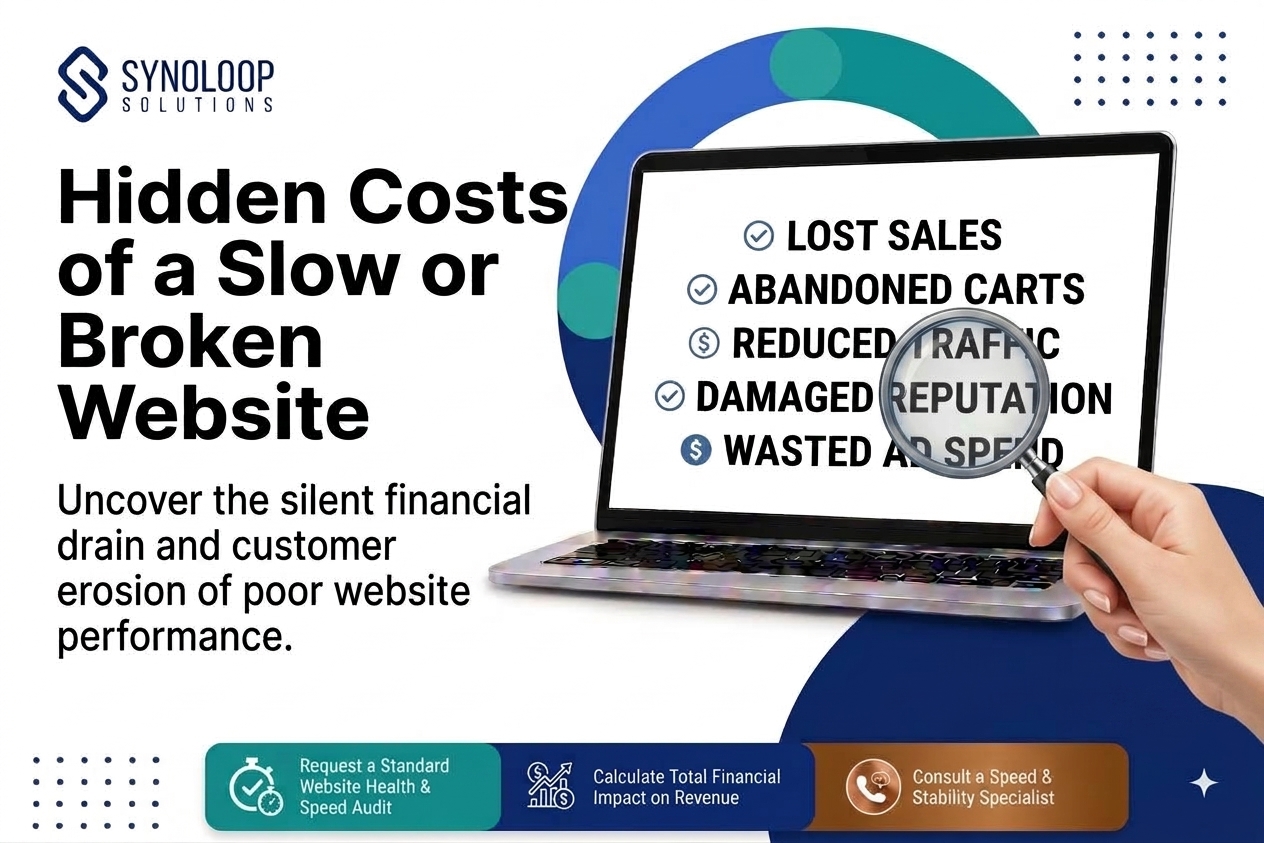
Your website may not be completely broken. Your homepage may still load, your navigation may appear to work, and customers may still be able to contact you. From the outside, everything can seem normal.
But a website does not have to be completely offline before it starts costing your business money. A slow page, broken form, difficult checkout, poor mobile experience, or technical problem that only affects certain users can quietly create losses that are much harder to notice.
These are the hidden costs of a slow or broken website.
Your Website Can Quietly Lose Customers
Visitors May Leave Without Telling You
When someone visits your website, they are already giving your business an opportunity. They may have searched for your service, clicked on an advert, received your business name from someone, or deliberately entered your website address because they wanted to learn more.
If the website takes too long to load, behaves strangely, or makes it difficult to find what they need, that visitor may simply leave. They may not send an email explaining what happened or call your business to complain. They may just go to another website.
This makes website performance particularly difficult to measure from complaints alone. Your team may hear from ten unhappy customers while hundreds of other visitors simply leave without saying anything.
A Broken Website Can Mean Lost Revenue
Small Technical Problems Can Interrupt a Sale
Your website does not need to be completely unavailable to affect your revenue. A single broken part of the customer journey can be enough to prevent someone from completing an action.
For an e-commerce business, that could be a product page that does not load correctly, a shopping cart that fails, a checkout problem, or a payment integration that does not respond properly. For a service business, it could be a contact form that fails to submit, a booking page that does not work, or an important call-to-action that leads nowhere.
The customer may not know that there is a technical problem. From their perspective, they simply could not complete what they came to your website to do. If they do not try again, the business may lose that sale or enquiry without ever knowing exactly why.
Your Website Can Affect Customer Trust
People Judge the Business Through the Website
Your website is often part of a potential customer's first interaction with your business. Before someone calls you, buys from you, or requests your service, they may visit your website to decide whether your business appears credible.
A website with broken links, outdated information, inconsistent layouts, missing images, slow pages, or features that do not work can create doubt. Even when the business itself is excellent, the website may communicate a different impression.
This is especially important for businesses that depend on trust before a customer makes a decision. Your website does not need to be the most visually impressive website on the internet, but it should be reliable, understandable, and capable of doing what visitors expect it to do.
Poor Performance Can Affect Your Visibility
Search Engines Also Need to Understand Your Website
Your website has to work for more than just your visitors. Search engines need to crawl your pages, understand your content, and determine which pages may be relevant to searches.
Technical problems such as poor site structure, indexing issues, broken links, slow performance, missing metadata, or problems with mobile usability can therefore become part of a larger SEO problem. Not every performance issue will automatically cause your rankings to fall, but technical health is still an important part of maintaining a website that can be discovered and understood.
This is why website performance and SEO should not always be treated as completely separate concerns. A website that is difficult to crawl or difficult for visitors to use may have problems in several areas at the same time.
Your Team Can Pay the Price Too
A Website Problem Can Become an Operations Problem
The hidden cost of a broken website is not always paid directly through lost sales. Your team can also end up paying for it through additional work.
If a contact form does not work, someone may have to manually collect information through phone calls or messages. If customers cannot find important information, your staff may repeatedly answer questions that your website should have handled. If an online booking system fails, someone may need to manage bookings manually.
These may seem like small inconveniences individually, but they can accumulate over time. Instead of your website helping your team serve customers, your team starts working around the website.
Ignored Problems Can Become More Expensive
Your Website Changes Over Time
A website is not a static asset. Your business changes, your content changes, new features are added, third-party services are updated, and the technology supporting your website evolves.
A website that worked properly when it was launched may therefore develop problems months or years later. Outdated software, incompatible packages, broken integrations, accumulated technical debt, and neglected security issues can become increasingly difficult to address.
This is why fixing problems early can be more practical than waiting until several smaller problems have turned into one large rebuild.
So, What Is Your Website Really Costing You?
The Development Cost Is Only Part of the Picture
When businesses think about the cost of a website, they often focus on how much they paid to build it. But the more important question may be what happens when that website does not perform properly.
A slow page can cause visitors to leave. A broken form can mean a lost enquiry. A failed checkout can mean a lost sale. Poor technical health can make your website harder to discover. A website that constantly creates work for your team can also become an operational burden.
You may never receive an invoice for these losses, which is why they are easy to overlook. They are still costs to the business.
Find Out What Is Wrong With Your Website
Your Website Should Work for Your Business
At Synoloop Solutions, we examine websites to identify problems affecting usability, performance, frontend systems, accessibility, SEO, and, depending on the audit level, deeper technical and security areas.
You do not have to wait until your website completely breaks before checking its condition. A regular assessment can help you identify problems while they are still manageable and give you a clearer idea of what needs to be fixed.
Our Free Website QuickScan provides an initial assessment of important areas of your website and can help you determine whether further investigation is necessary.
Your website already costs money to build, host, maintain, and operate.
The real question is whether it is also quietly costing your business customers, revenue, time, and trust.
Get Your Free Website QuickScan → synoloopsolutions.com.ng/contact?quickscan=1
Explore Our Website Audit Services → synoloopsolutions.com.ng/web-audit
Contact Synoloop Solutions → synoloopsolutions@gmail.com
Follow Synoloop Solutions: LinkedIn · X · Instagram · TikTok · Facebook