Web Audit
llms.txt Explained: What It Does and What It Doesn't
However, `llms.txt` has also attracted many claims about AI search, rankings, citations, and website visibility. Some of those claims go much further than what the file is actually designed to do.
Synoloop Solutions 7 min read
Imagine a software company has a large documentation website with hundreds of pages covering its API, installation instructions, tutorials, examples, and technical references.
A developer asks an AI tool, “How do I authenticate with this company's API?” The company would ideally want the AI system to find the most useful documentation rather than having to work through every page on the website.
This is one of the problems that llms.txt was proposed to address.
However, llms.txt has also attracted many claims about AI search, rankings, citations, and website visibility. Some of those claims go much further than what the file is actually designed to do.
So what exactly is llms.txt, what does it do, and what doesn't it do?
What Is llms.txt?
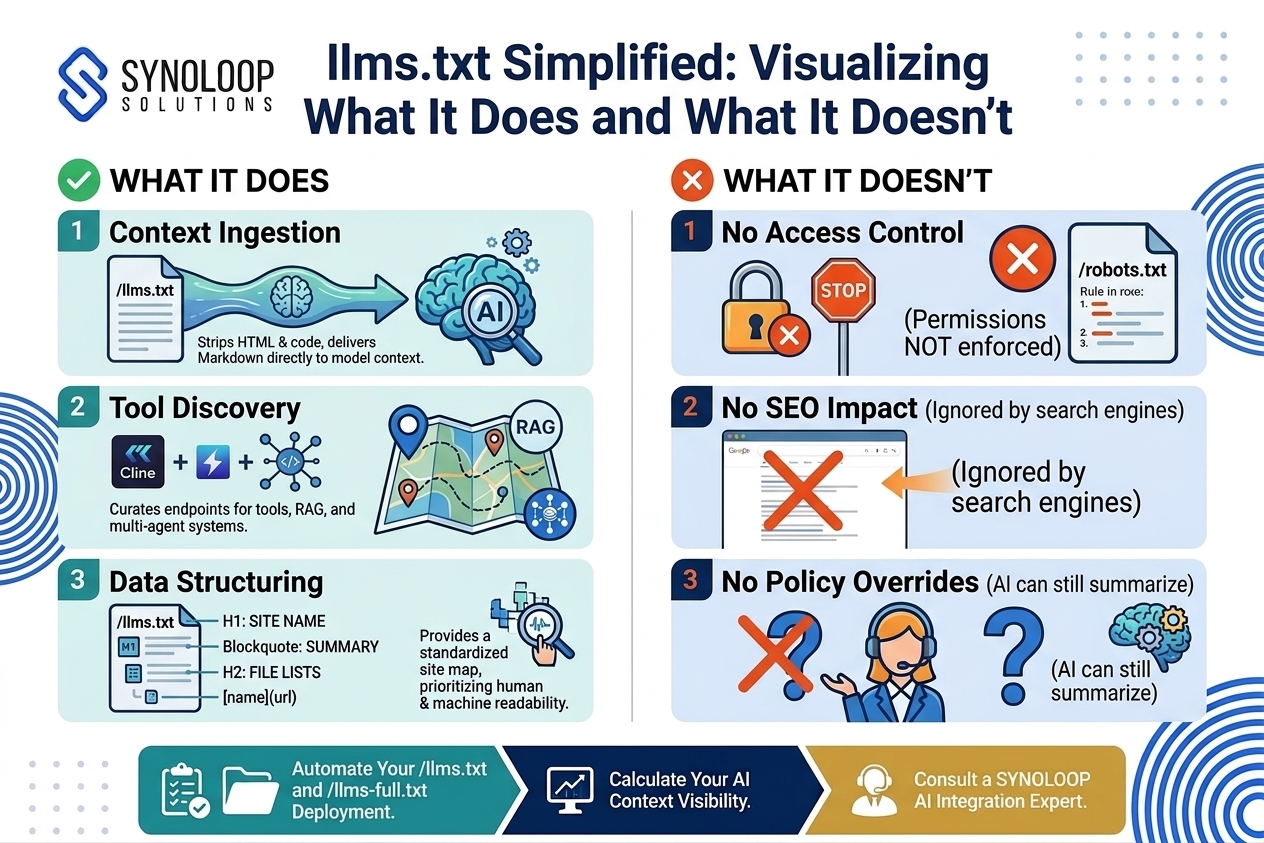
llms.txt is a proposed standard that allows websites to provide AI systems with a curated list of important information about the website.
The basic idea is simple. A website places a file called llms.txt at its root, usually at a location such as https://example.com/llms.txt. The file can contain a short description of the website along with links to important pages or resources.
The goal is to give language models a useful starting point when trying to understand a website, particularly when the website contains a large amount of information.
It is therefore better understood as a way of curating and organising information for AI systems, rather than as a magic SEO file.
Why Was llms.txt Proposed?
Large websites can contain an enormous amount of information.
A software company might have documentation, API references, tutorials, changelogs, FAQs, support articles, and product pages. While all of these may be useful, they are not necessarily equally important when an AI system is trying to answer a particular question.
llms.txt was proposed as a way for website owners to identify the resources they consider most useful.
For example, a software company could use it to point toward its:
- Getting-started documentation.
- API references.
- Installation guides.
- Important tutorials.
- Product documentation.
Instead of simply presenting an AI system with hundreds or thousands of URLs, the website can provide a curated path toward its most important resources.
What Does llms.txt Do?
The simplest way to think about llms.txt is:
It tells an AI system, “Here are some of the most useful resources on this website.”
A properly created file can provide a concise description of the website and direct systems toward selected resources.
This can be particularly useful for websites where information is extensive or complicated. A large technical documentation website, for example, may have hundreds of pages that are difficult to summarise simply from its homepage.
By creating a curated list, the website owner can indicate which resources are particularly important.
What llms.txt Does NOT Do
This is the most important part to understand.
llms.txt should not be treated as a guaranteed AI-search ranking mechanism.
It does not:
-
Guarantee higher Google rankings. Creating an
llms.txtfile does not automatically improve a website's position in Google's search results. -
Guarantee AI citations. Adding the file does not mean ChatGPT, Gemini, Claude, Perplexity, or another AI system will automatically cite the website.
-
Guarantee AI recommendations. A business does not become more likely to be recommended simply because it has an
llms.txtfile. -
Replace SEO. Technical SEO, content quality, accessibility, crawlability, indexing, internal linking, and other website fundamentals still matter.
-
Fix bad content. If the pages linked from the file contain vague, inaccurate, or poor-quality information,
llms.txtcannot fix those problems. -
Force AI systems to use the file. The existence of a file does not mean every AI system will read it or follow its recommendations.
This distinction is important because businesses should not spend time implementing something simply because it is being described online as a shortcut to AI visibility.
llms.txt Is Not the Same as robots.txt
The names make these two files sound similar, but they serve different purposes.
robots.txt is primarily used to provide instructions to automated crawlers about which parts of a website they may or may not access.
llms.txt, on the other hand, was proposed as a way to provide AI systems with a curated overview of useful website resources.
In simple terms, robots.txt is about crawler access, while llms.txt is about curating information for language models.
They should not be treated as interchangeable.
Does llms.txt Improve AI Search Visibility?
The answer needs some caution.
The purpose of llms.txt is to make important information easier for language models to find and understand. However, that does not mean publishing the file guarantees that an AI system will use it or that a website will appear in an AI-generated answer.
Different AI systems obtain and process information differently. Some may use search indexes, some may crawl websites, some may use other sources, and their methods can change over time.
Therefore, businesses should think of llms.txt as a potential supporting mechanism, not a guaranteed AI visibility strategy.
Who Is llms.txt Most Useful For?
The usefulness of llms.txt depends heavily on the type of website.
It may be more relevant for websites that contain large collections of information, such as:
- Software documentation websites.
- Developer platforms.
- Technical knowledge bases.
- Large public documentation libraries.
- Organisations with extensive online resources.
A small business website with five or ten straightforward pages may have less need for a curated AI resource file.
That does not mean such a website cannot create one. It simply means the practical benefit may be smaller.
What Should a Good llms.txt Contain?
The purpose of the file is curation, so it should focus on useful and important information rather than becoming a list of every URL on the website.
For a software company, that could include:
- A short description of the company or product.
- Getting-started documentation.
- API documentation.
- Important technical guides.
- Other authoritative resources.
The exact content should depend on the website.
The important principle is that the file should make it easier to identify the resources that actually matter.
A Simple Example
A simplified llms.txt file might look like this:
# Example Software

Example Software provides tools for managing business data.

## Documentation

- [Getting Started](https://example.com/docs/getting-started)
- [API Reference](https://example.com/docs/api)
- [Authentication](https://example.com/docs/authentication)

## Products

- [Product Overview](https://example.com/products)
- [Pricing](https://example.com/pricing)
The important part is not the exact wording of this example. The idea is that the file provides a concise description and directs an AI system toward useful resources.
Should Every Business Create One?
No.
There is a tendency for every new AI-related development to become another item on a business website's technical checklist. That can lead companies to spend time implementing things without first asking whether they solve an actual problem.
A business should first look at the structure and purpose of its website.
If the website contains extensive documentation or a large collection of resources, creating a curated file may make sense.
If the website is small and its important information is already clearly organised and accessible, the value may be limited.
The decision should be based on the website's needs rather than fear of missing out on AI search.
What Matters More Than llms.txt?
For most businesses, website fundamentals should come first.
A website should be technically accessible, important pages should be discoverable and indexable, and the content should clearly explain what the business does.
Customers should be able to understand the company's services, products, pricing, processes, locations, and other important information without unnecessary difficulty.
Internal links should connect related information, and structured data should be implemented appropriately where relevant.
These fundamentals help both people and search systems understand the website.
A business with excellent content and a technically sound website is in a much stronger position than a business with poor content that simply happens to have an llms.txt file.
The Bigger Picture
llms.txt is interesting because websites are increasingly being interpreted not only by humans but also by systems that need to understand and summarise information.
As websites become larger and more complicated, providing clear information architecture and useful content becomes increasingly important.
However, businesses should distinguish between proposed standards, technical recommendations, and proven search ranking factors.
That distinction prevents companies from treating every new AI-related development as an immediate ranking requirement.
So, Should Your Website Have an llms.txt File?
Maybe.
If a website contains a large amount of valuable information, particularly technical documentation or resources that need to be curated, llms.txt may be worth exploring.
If the website is small, the priority should usually be improving the existing website itself.
The file is not the strategy.
The information behind the file is what matters.
llms.txt can provide a curated path toward important information, but it should be viewed as one possible component of a broader approach to website structure, content, SEO, and AI search.
How Synoloop Can Help
Synoloop Solutions helps businesses examine whether their websites are technically sound, understandable, accessible, and useful to the people and systems interacting with them.
A website audit can identify problems across UI/UX, frontend systems, accessibility, and SEO, while also highlighting areas where important business information may be unclear, difficult to find, or poorly structured.
Businesses can start with the QuickScan, a free 24-hour website review limited to five businesses per month. For businesses that need a deeper assessment, Synoloop also offers Standard and Premium website audits.
If your business is preparing its website for modern search and AI-driven discovery, the first step should not be adding every new AI-related file you hear about.
It should be making sure the website itself provides clear, useful, and trustworthy information.
Get Your Free Website QuickScan → synoloopsolutions.com.ng/contact?quickscan=1
Explore Our Website Audit Services → synoloopsolutions.com.ng/web-audit
Contact Synoloop Solutions → synoloopsolutions@gmail.com
Follow Synoloop Solutions: LinkedIn · X · Instagram · TikTok · Facebook